
5 Grief Books Our Therapists Recommend
Our therapists understand grief not just professionally, but personally. We've experienced our own losses, sat with our own pain, and know firsthand how isolating and overwhelming grief can feel. This lived experience, combined with clinical training, shapes the way we support clients through their darkest moments.
Key Takeaways
Grief looks different for everyone, and there is no single "right" way to experience or express it
The books recommended offer a variety of perspectives so readers can find support that aligns with their own needs, pace, and style of healing
Reading about grief can provide language, validation, and comfort during moments when emotions feel hard to name or navigate
While books offer meaningful support, connecting with a grief therapist can help you process grief in a more personalized and compassionate way
How Books Can Support Your Grief Journey
Grief literature serves a unique purpose in the healing process. Between therapy sessions, books provide a constant companion—offering validation when you feel most alone and language for experiences that seem impossible to express.
The right book can help you understand that your grief response is normal, give you practical tools for difficult moments, and show you that others have walked this painful path before you. While books can't replace professional support, they can be powerful allies in your journey through loss.
5 Grief Book Recommendations To Help You Heal
These books are intended to offer language, solace, and practical perspective between therapy sessions.
Trigger note: These titles address death and loss directly and may feel intense. Each entry below includes a quick note on who the book is best for, so you can find the right match for your situation and stage of grieving.
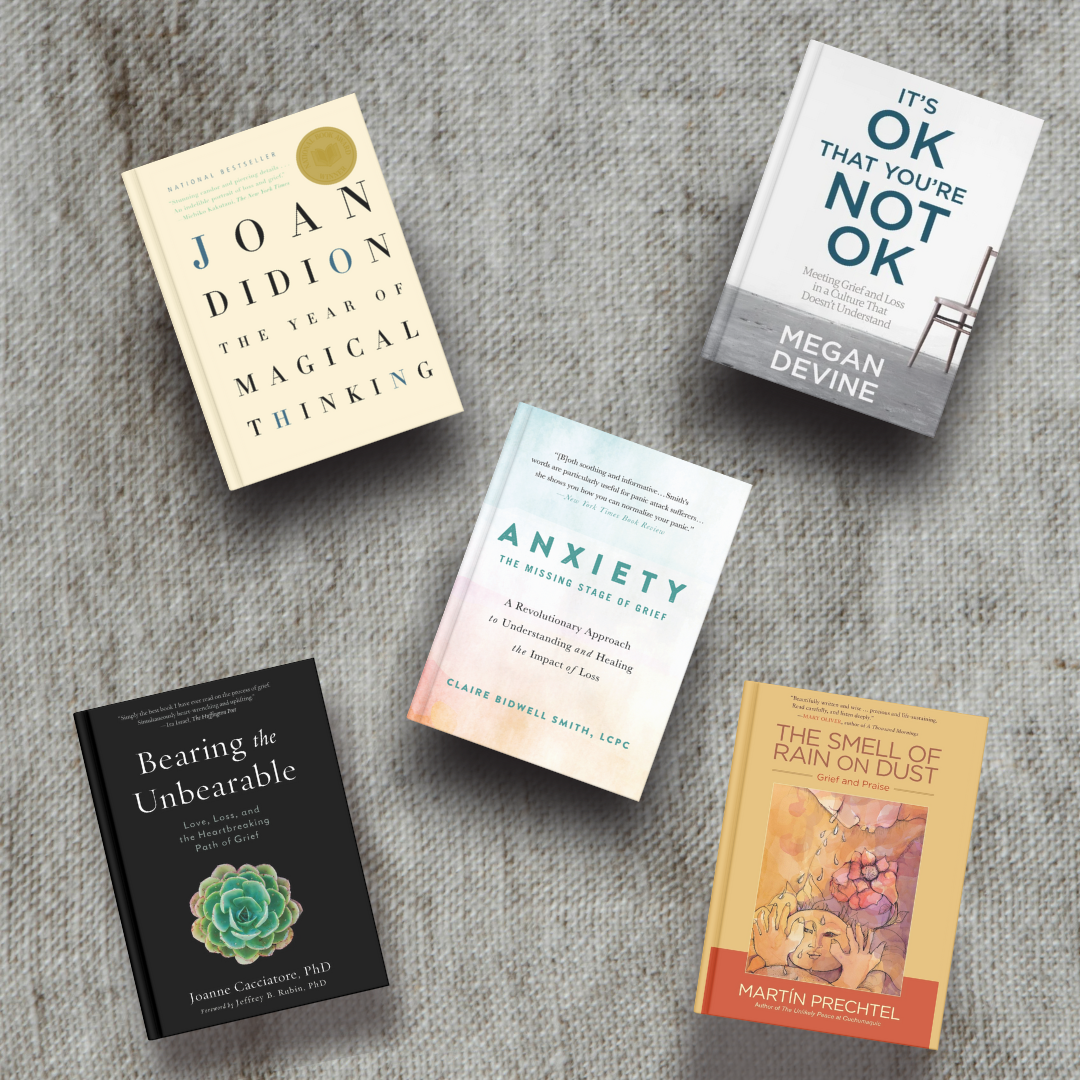
1. Bearing the Unbearable – Joanne Cacciatore
Dr. Joanne Cacciatore is a bereavement educator, researcher, Zen priest, leading counselor, professor at Arizona State University, and founder of the MISS Foundation. This book is a companion for life's most difficult times, revealing how grief can open hearts to connection, compassion, and the essence of shared humanity as compiled into 52 short chapters.
Dr. Gabor Maté praised it as "beautifully written" and valuable for "all those who have grieved, will grieve, or support others through bereavement."
What Readers Say:
The Huffington Post called it "simultaneously heartwrenching and uplifting," noting it's "destined to be a classic, simply the best book I have ever read on the process of grief." Multiple readers reported their therapists recommended this book to them.
Best for:
Those experiencing traumatic or child loss
Readers who need permission to grieve without a timeline
People seeking a compassionate, non-judgmental approach
Anyone feeling their grief is "too much" or socially unacceptable
Learn more about the author: Dr. Joanne Cacciatore
2. The Smell of Rain on Dust – Martín Prechtel
Martín Prechtel is a shaman trained in the Tzutujil Maya tradition who teaches at his international school Bolad's Kitchen in New Mexico. Prechtel shares profound insights on the relationship between grief and praise, explaining that "grief expressed out loud for someone we have lost... is in itself the greatest praise we could ever give them. Grief is praise, because it is the natural way love honors what it misses."
What Readers Say:
Poet Mary Oliver praised it as "beautifully written and wise," offering "stories that are precious and life-sustaining." One reader wrote: "This beautiful, poetic book on grief filled my aching heart... His words will heal you."
The book is described as "a must-read for death and grief workers, all those who take part in burying and honoring our dead, and anyone who feels their grief is more than what is socially acceptable."
Best for:
Those seeking a spiritual or indigenous perspective on grief
Readers who appreciate poetic, metaphorical language
People interested in understanding grief as a cultural practice
Anyone who feels modern society doesn't make space for their grief
Learn more about the author: Martín Prechtel
3. Anxiety: The Missing Stage of Grief – Claire Bidwell Smith
Claire Bidwell Smith is a licensed therapist (LCPC) specializing in grief with a thriving private practice, who has been featured in The New York Times, The Atlantic, Washington Post, and CNN.
Our therapists frequently recommend this book to clients who are experiencing anxiety in the wake of loss. So many people don't realize their panic attacks or persistent worry are connected to unprocessed grief. This book helps them understand that anxiety isn't a separate problem—it is often grief showing up in disguise.
This book breaks down the physiology of anxiety, explaining how significant loss and unresolved grief are primary underpinnings of anxiety, taking a step beyond Kübler-Ross's five stages: denial, anger, bargaining, depression, and acceptance.
What Readers Say:
One reader gave it "five enthusiastic stars," describing it like "overhearing a conversation between a beautiful and gifted writer and the most incisive therapist."
Best for:
Those experiencing anxiety, panic attacks, or hypervigilance after loss
People who feel "on edge" or unable to relax since their loss
Readers looking for practical coping strategies alongside understanding
Anyone whose grief manifests more as worry than sadness
Learn more about the author: Claire Bidwell Smith
4. The Year of Magical Thinking – Joan Didion
The title refers to magical thinking in the anthropological sense—thinking that if a person hopes for something enough or performs the correct actions, an unavoidable event can be averted.
The book follows Didion's reliving and reanalysis of her husband's death throughout the following year, incorporating medical and psychological research on grief and illness. It is also important to note that this book is a memoir, not self-help.
Didion applies the reportorial detachment for which she is known to her own experience of grieving, with few expressions of raw emotion, instead observing and analyzing changes in her behavior to indirectly express the toll her grief is taking.
What Readers Say:
The book won the National Book Award for Nonfiction in 2005 and has been recognized as one of The New York Times's and The Guardian's 100 Best Books of the 21st Century.
Neuroscientist Mary-Frances O'Connor, who directs the Grief, Loss and Social Stress Lab at the University of Arizona, often uses Didion's example of not being able to give away her husband's shoes in her own book "The Grieving Brain" to explain the neuroscience behind magical thinking in grief.
Best for:
Those who appreciate literary, intellectual approaches to grief
Readers navigating sudden, unexpected loss (especially spousal loss)
People experiencing "irrational" thoughts and needing validation
Those interested in understanding the cognitive aspects of grief
Readers who prefer observation over sentimentality
Learn more about the author: Joan Didion Biography
5. It's OK That You're Not OK – Megan Devine
Megan Devine is a licensed psychotherapist (LPC) who has run a private consulting practice for over 20 years and witnessed the accidental drowning of her partner, giving her both professional and personal perspectives on grief.
Devine debunks the culturally prescribed goal of returning to a normal, "happy" life, replacing it with a healthier middle path that invites us to build a life alongside grief rather than seeking to overcome it.
What Readers Say:
Readers consistently describe this book as validating and permission-giving, especially for those tired of unhelpful platitudes about finding silver linings or believing that "everything happens for a reason."
Best for:
Anyone frustrated by "silver lining" platitudes and toxic positivity
Those feeling pressure to "move on" or "get back to normal"
Readers seeking validation that their grief is legitimate as it is
People wanting practical language to use with unhelpful friends/family
Anyone tired of being told "everything happens for a reason"
What Our Therapists Want You to Know About Grief
The Transformative Nature of Grief
Tatiana Kovalsky, APCC shares her perspective on the grief process:
"Grief is a multifold expression of what it means to be human, and what it means to love and care for the world and the people in it. It can shatter us in ways that allow the light within us to finally be expressed, to rebuild ourselves with the wisdom that is often implicit in loss."
This understanding shapes our approach to grief counseling and bereavement support. Grief is not something to "get over," but a profound human experience that can transform us when we allow ourselves to move through it with compassion and support.
Another Grief Book Our Therapists Recommend
Tatiana also recommends No Bad Parts by Richard Schwartz for understanding grief through Internal Family Systems (IFS) therapy. This approach helps identify the different parts of ourselves that respond to loss and how to work with them compassionately.
Grief is not a journey you have to walk alone. While books can provide valuable support and insight, professional guidance can make a significant difference in your healing process.
Frequently Asked Questions About Grief Books
Can reading books really help with grief?
Yes, grief books provide validation, expert guidance, and language for feelings that seem impossible to express. They work best as a complement to—not a replacement for—professional grief counseling or therapy.
When is the right time to start reading about grief?
There's no perfect timeline. Some people find comfort immediately after a loss, while others need weeks or months. Listen to your own needs, and start with just a few pages at a time if reading feels overwhelming.
Should I read multiple grief books or focus on one?
This depends on your personal preference. Some people benefit from reading one book deeply, while others find value in exploring different perspectives. If you're experiencing both grief and anxiety, you might benefit from reading books that address both experiences.
What if the grief book doesn't resonate with me?
Not every book will fit your experience, and that's completely normal. Give yourself permission to stop reading and try a different title or approach—perhaps a memoir if self-help feels too clinical, or vice versa.
Are grief books different from grief therapy?
Yes, they serve complementary purposes. Books provide information and tools you can access anytime, while therapy offers personalized support and a safe space to process your unique grief experience. Many therapists recommend books as part of a comprehensive treatment plan.
Get Professional Grief Counseling Support in Los Angeles
While grief books provide valuable insights, working with a professional grief counselor offers personalized guidance through your unique loss experience. At Highland Park Holistic Psychotherapy, our therapists take a compassionate, holistic approach that honors all aspects of your grief—physical, spiritual, and psychological.
We support all types of loss, including death of loved ones, job loss, relationship endings, and major life transitions. Our integrative approach addresses the mind, body, and spirit through grief counseling, EMDR therapy, trauma therapy, and more—available both in-person and through teletherapy for California residents.
Ready to begin your healing journey? Book a free consultation with our Care Coordinator to learn how we can support you.
Other Services Offered with Highland Park Holistic Psychotherapy
At Highland Park Holistic Psychotherapy, we provide a wide range of mental health services, including depression therapy, anxiety treatment, grief counseling, trauma therapy, and other services, including online therapy, in our Los Angeles, CA office. You can also read more by visiting our blog or FAQ page.